
Case study
Samsung Quintupled VPP Participation By Adding In-App Enrollment Prompts


Powering Rapid Growth for Daily-Dispatched Behind the Meter Battery VPPs
About Samsung SmartThings
SmartThings, Samsung’s global connected living platform, builds smart homes that are convenient, safe, sustainable and fun. Millions of people, in nearly 200 countries, use SmartThings to easily control their connected homes and IoT devices. SmartThings delivers simple, powerful experiences across Samsung’s leading portfolio of phones, TV, and appliances.
About Samsung SmartThings
SmartThings, Samsung’s global connected living platform, builds smart homes that are convenient, safe, sustainable and fun. Millions of people, in nearly 200 countries, use SmartThings to easily control their connected homes and IoT devices. SmartThings delivers simple, powerful experiences across Samsung’s leading portfolio of phones, TV, and appliances.
Results
By simplifying the user experience, strategically repositioning enrollment, and introducing automated re-engagement, Samsung dramatically accelerated Flex Connect adoption.
The impact of the June 30th redesign was immediate:
5X increase in daily and weekly meter authorizations.
Significant reduction in onboarding drop-offs
Streamlined user journey from device setup to grid participation.


Solution
Integrating Enrollment Device Setup
Leaning on marketing insights and early campaign results, Leap and Samsung identified a strategic opportunity to scale Flex Connect sign-ups: targeting users during initial device configuration—the moment of peak engagement.
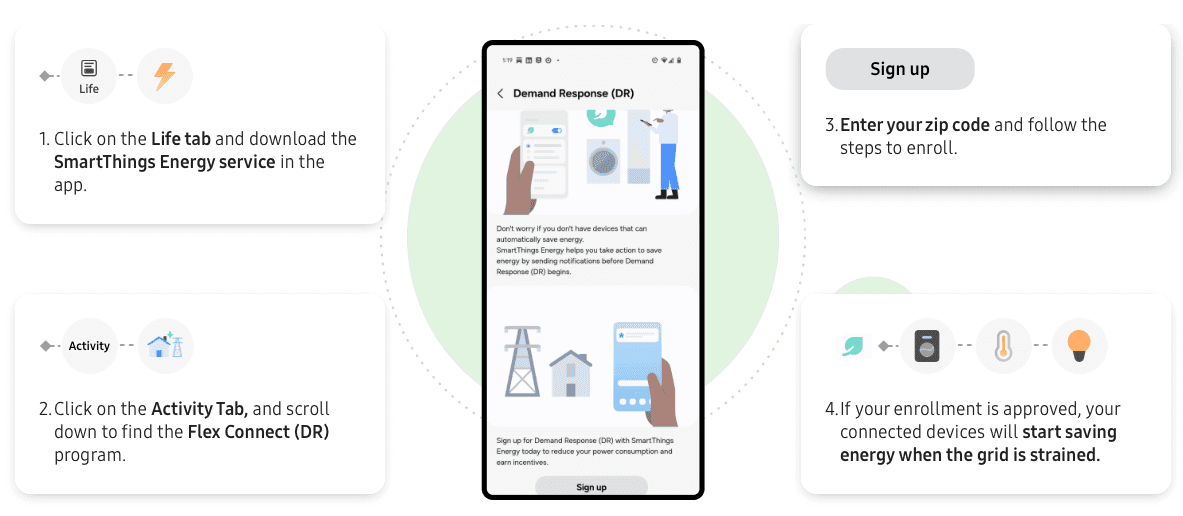
Recognizing that these users were already active within the ecosystem, Samsung introduced a localized qualification step. Integrated directly into the app release cycle, the system began prompting users for their zip code during the SmartThings Energy setup. If the user’s location was within an eligible region, they were fast-tracked directly to the Flex Connect enrollment screen.
By streamlining this path, Samsung allowed eligible customers to bypass additional service layers and land directly on the signup portal. To further optimize conversion, Samsung leveraged Leap’s Connect API to automatically re-engage users who had dropped out of the funnel, recovering sign-ups that might otherwise have been lost.
Ultimately, Flex Connect was transformed from a buried service add-on into a visible, intuitive offering, leading to a sharp increase in demand response participation.
This collaboration demonstrates how thoughtful CX design—combined with Leap’s technology—can unlock large-scale residential participation in grid services.
Challenges
Despite being a technological leader in energy storage VPPs, sonnen faced new hurdles at it looked to expanding its VPP model:
Operational and Regulatory Fragmentation
Each U.S. energy market operates under its own complex regulatory framework. Expanding efficiently into new geographies was resource-intensive. sonnen needed a partner that could provide local expertise, operational scalability, and automated infrastructure — especially since the company would need incremental headcount to manage new programs independently.
Background
Samsung has identified grid services as a key strategic initiative to evolve the SmartThings ecosystem, with the goals of differentiating the platform through enhanced SmartThings Energy offerings, unlocking new revenue streams, increasing customer satisfaction, and contributing to grid stability and lowering carbon emissions.
In 2024, Samsung partnered with Leap to launch Flex Connect, a demand response program powered by SmartThings Energy. By leveraging advanced features such as AI Energy Mode and intelligent automations, Flex Connect empowers users to contribute to a greener grid. The service is seamlessly integrated into the SmartThings app, rewarding eligible users with Samsung Rewards points for automating their energy savings and participating in the future of energy management.
Ultimately, Flex Connect was transformed from a buried service add-on into a visible, intuitive offering, leading to a sharp increase in demand response participation.
Background
Samsung has identified grid services as a key strategic initiative to evolve the SmartThings ecosystem, with the goals of differentiating the platform through enhanced SmartThings Energy offerings, unlocking new revenue streams, increasing customer satisfaction, and contributing to grid stability and lowering carbon emissions.
In 2024, Samsung partnered with Leap to launch Flex Connect, a demand response program powered by SmartThings Energy. By leveraging advanced features such as AI Energy Mode and intelligent automations, Flex Connect empowers users to contribute to a greener grid. The service is seamlessly integrated into the SmartThings app, rewarding eligible users with Samsung Rewards points for automating their energy savings and participating in the future of energy management.

The Challenge
Reducing Enrollment Friction
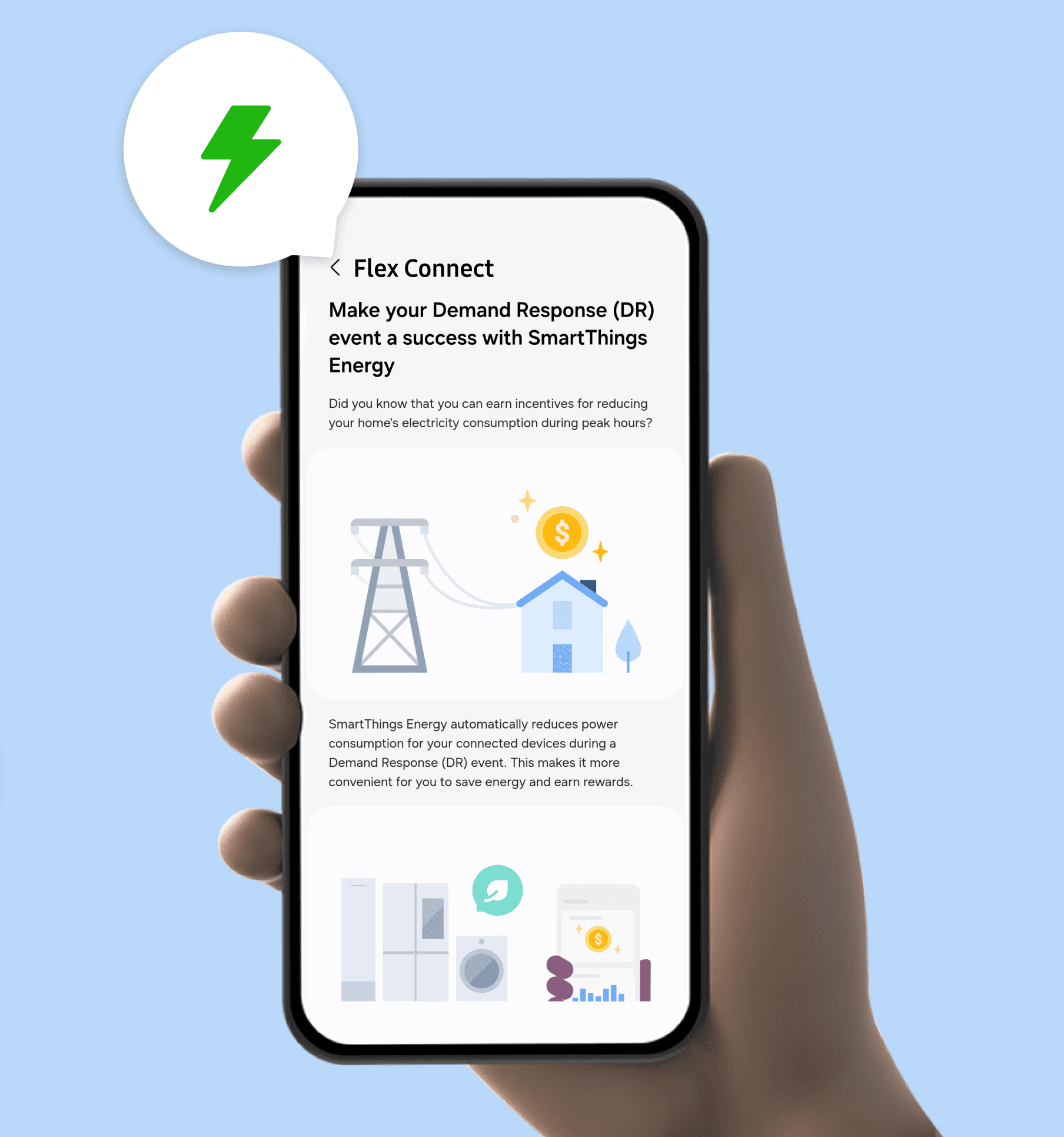
Enrolling residential customers in grid services is inherently complex. These programs often require multi-step utility data authorizations that can create friction in the enrollment journey. For Samsung’s Flex Connect program, the journey involved several prerequisite layers: users first had to discover and download the SmartThings Energy service, then navigate further into the service to locate the enrollment portal.
Furthermore, participation required active device integration. Users needed to connect their smart energy devices and manually enable DR mode to begin saving energy during grid strain. To overcome these hurdles, Samsung sought to simplify the path to participation by placing Flex Connect messaging directly in front of eligible users and incentivizing enrollment by amplifying Samsung Rewards.
Solution
Integrating Enrollment Device Setup
Leaning on marketing insights and early campaign results, Leap and Samsung identified a strategic opportunity to scale Flex Connect sign-ups: targeting users during initial device configuration—the moment of peak engagement.
Recognizing that these users were already active within the ecosystem, Samsung introduced a localized qualification step. Integrated directly into the app release cycle, the system began prompting users for their zip code during the SmartThings Energy setup. If the user’s location was within an eligible region, they were fast-tracked directly to the Flex Connect enrollment screen.
Solution
Integrating Enrollment Device Setup
Leaning on marketing insights and early campaign results, Leap and Samsung identified a strategic opportunity to scale Flex Connect sign-ups: targeting users during initial device configuration—the moment of peak engagement.
Challenges
Despite being a technological leader in energy storage VPPs, sonnen faced new hurdles at it looked to expanding its VPP model:
Operational and Regulatory Fragmentation
Each U.S. energy market operates under its own complex regulatory framework. Expanding efficiently into new geographies was resource-intensive. sonnen needed a partner that could provide local expertise, operational scalability, and automated infrastructure — especially since the company would need incremental headcount to manage new programs independently.
Background
Samsung has identified grid services as a key strategic initiative to evolve the SmartThings ecosystem, with the goals of differentiating the platform through enhanced SmartThings Energy offerings, unlocking new revenue streams, increasing customer satisfaction, and contributing to grid stability and lowering carbon emissions.
In 2024, Samsung partnered with Leap to launch Flex Connect, a demand response program powered by SmartThings Energy. By leveraging advanced features such as AI Energy Mode and intelligent automations, Flex Connect empowers users to contribute to a greener grid. The service is seamlessly integrated into the SmartThings app, rewarding eligible users with Samsung Rewards points for automating their energy savings and participating in the future of energy management.

By streamlining this path, Samsung allowed eligible customers to bypass additional service layers and land directly on the signup portal. To further optimize conversion, Samsung leveraged Leap’s Connect API to automatically re-engage users who had dropped out of the funnel, recovering sign-ups that might otherwise have been lost.
Ultimately, Flex Connect was transformed from a buried service add-on into a visible, intuitive offering, leading to a sharp increase in demand response participation.
This collaboration demonstrates how thoughtful CX design—combined with Leap’s technology—can unlock large-scale residential participation in grid services.


Recognizing that these users were already active within the ecosystem, Samsung introduced a localized qualification step. Integrated directly into the app release cycle, the system began prompting users for their zip code during the SmartThings Energy setup. If the user’s location was within an eligible region, they were fast-tracked directly to the Flex Connect enrollment screen.
By streamlining this path, Samsung allowed eligible customers to bypass additional service layers and land directly on the signup portal. To further optimize conversion, Samsung leveraged Leap’s Connect API to automatically re-engage users who had dropped out of the funnel, recovering sign-ups that might otherwise have been lost.
Ultimately, Flex Connect was transformed from a buried service add-on into a visible, intuitive offering, leading to a sharp increase in demand response participation.