Blog
Blog
Using VPPs and Virtual Interconnection to Accelerate Data Center Development
Using VPPs and Virtual Interconnection to Accelerate Data Center Development

Thomas Folker, Co-Founder and Chief Strategy Officer

This is Part 1 of our series on data centers & VPPs. Read Part 2 and Part 3.
When we founded Leap in 2018, we saw an opportunity to unlock the power of distributed energy resources (DERs) as a flexible, dispatchable grid asset. By connecting DERs to energy markets, we’ve helped technology providers differentiate their offerings, given grid operators a new tool to manage peak demand, and enabled customers to participate directly in the clean energy transition.
In the years since, that early vision has begun to scale. DER adoption has surged, electricity demand has grown sharply, and virtual power plants (VPPs) have proven their capability to deliver real-time capacity that reduces reliance on fossil-fueled peaker plants.
But the energy landscape is shifting again, and much faster than expected.
AI Is Accelerating the Grid Crunch
The rapid rise of AI is driving unprecedented demand for new data center capacity. According to the International Energy Agency, global data center electricity consumption could double by 2026, driven largely by AI training and inference workloads. At the same time, U.S. interconnection queues have ballooned to over 2,600 GW of generation and storage waiting to be connected, and the average interconnection timeline has stretched to five years or more (source: Berkeley Lab).
RMI recently highlighted that most grid operators are unprepared for this surge. And the market’s default responses (building new thermal generation or constructing new substations) are slow, expensive, carbon-intensive, and often misaligned with the urgency of AI-driven demand.
The good news is that DERs can help here, too. In fact, for many types of data center projects, especially smaller builds sited in more dense areas, DERs and VPPs may be the only near-term path to securing the capacity needed to get projects approved.
Not All Data Centers Are Created Equal
Most public attention is on hyperscalers with their massive, utility-scale facilities that support cloud platforms and large-scale model training. These are typically located far from population centers, seek large amounts of inexpensive power, and often require new substations or long-lead transmission upgrades.
But there’s another wave of data center growth that looks very different.
Colocation data centers (smaller, modular, and located closer to end users) are projected to make up the majority of newly announced facilities, according to McKinsey. As machine learning models evolve, hyperscalers are expected to focus on training while colocation sites will be used to handle inference, edge workloads, and latency-sensitive applications for the growing ecosystem of startups and enterprise AI teams.
Because these facilities are situated within existing distribution grids, they face tighter constraints, and often greater interconnection challenges, than hyperscalers. Yet they also represent the fastest-growing segment of the market.
To be approved, colocation developers must still bring new power to the table. And that’s where VPPs can fundamentally change the timeline.
VPPs as a New Power Source for Data Centers
Virtual power plants aggregate DERs—storage, smart appliances and systems, EV infrastructure, and anything with flexible load—and make them available as dispatchable capacity to grid operators. Today, automation and real-time controls enable highly responsive, highly targeted capacity delivery.
Data centers can participate directly in VPPs through onsite DERs such as batteries or backup generation and through flexible computing workloads that can modulate demand at critical times. But VPPs also unlock a more transformative use case for developers: Interconnection.
Virtual Interconnection: Accelerating the Path to Approval
Virtual interconnection uses VPP capacity to secure or accelerate utility approval for new data center load. Rather than waiting years for new grid upgrades, developers can contract for local dispatchable flexibility—effectively supplying the equivalent of firm capacity through DERs.
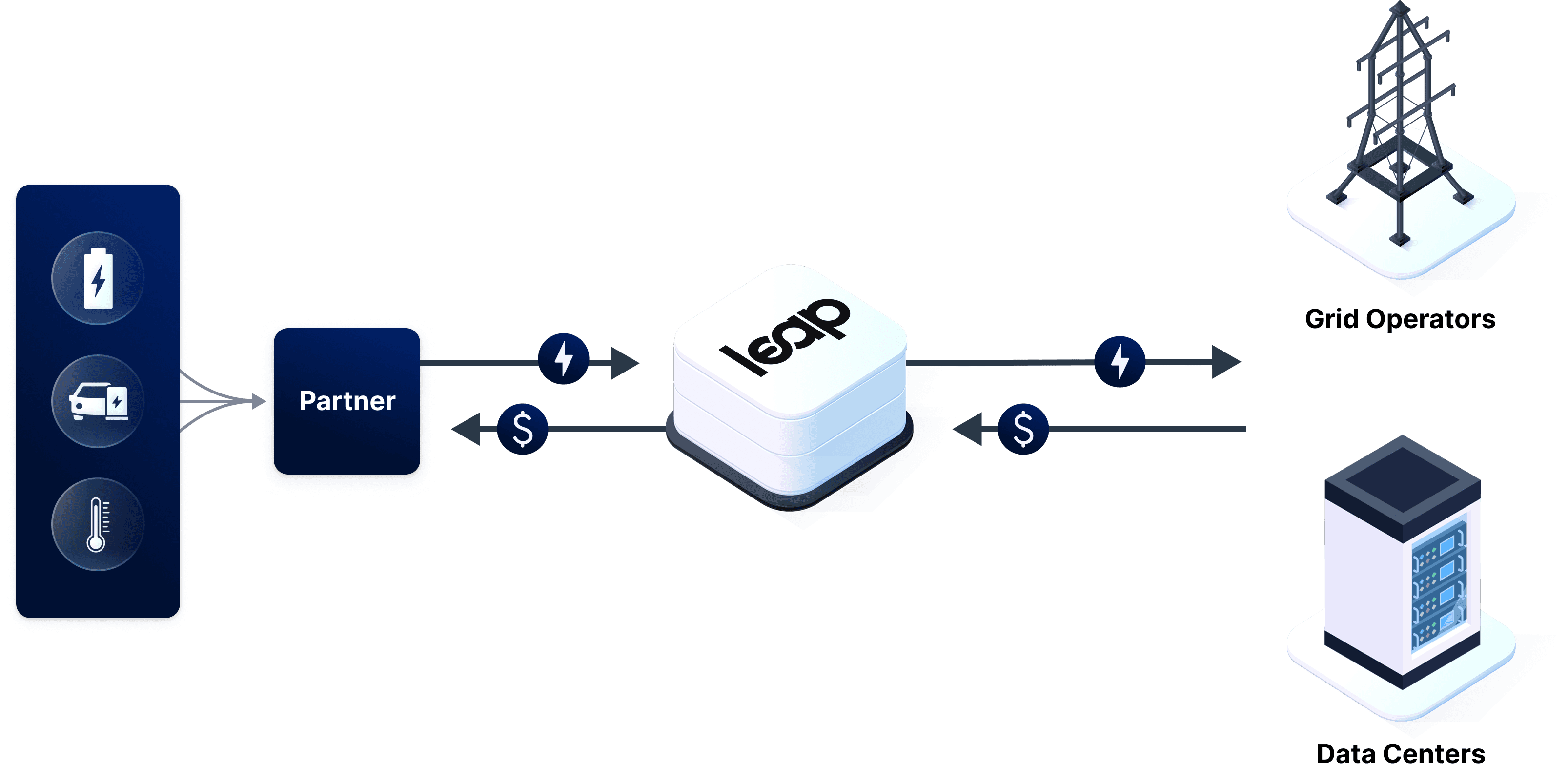
Leap aggregates DERs in the local distribution area—either existing resources or newly deployed assets.
The aggregated capacity is committed to the utility or grid operator as dispatchable load relief.
The developer uses this committed capacity as part of their interconnection application to demonstrate they can mitigate peak load impacts. Think of this as offsite allocated headroom that is as good as onsite firm capacity.
Utilities gain confidence that the project will not trigger immediate upgrades, being able to defer timeline to complete capital improvements.
Data center developers or load serving entities fund payments to DER providers for participating in VPPs, similar to capacity payments for wholesale market programs and other demand response programs.
This approach provides several benefits:
Fast: VPPs can be built from existing DERs or rapidly deployed new assets—far faster than the time needed to build new capacity generation or make required infrastructure upgrades.
Local: Capacity is sourced from DERs in the same local grid where the data center will operate, helping defer or eliminate distribution-level upgrades while also benefiting the community through direct monetary incentives for grid services participation as well as greater grid resilience. No socialized rate-hikes, but the inverse: money back in the pockets of consumers that own DERs and enroll them in VPPs.
Cost-effective: Because VPPs rely on existing DERs and no major capex, developers can reduce risk and avoid significant upfront Capex or multimillion-dollar interconnection surprises.
Clean: VPP-enabled peak reduction displaces inefficient peaker plants and aligns data center growth with climate commitments.
Performance Is What Matters Most
Ultimately, grid operators evaluate one thing above all else: will the committed capacity show up when it’s needed?
VPPs have demonstrated this repeatedly. Operational advancements—particularly automated dispatch, device controls software, and performance analytics—continue to improve reliability at scale.
Leap’s platform now manages almost 400 MW of flexible capacity across more than 100 partners and 400,000 customer sites at the device level. Over the past year, increased automation and event-performance monitoring have helped our partners consistently deliver strong results during peak events, flattening demand and providing dependable relief to stressed local grids.
The Path Forward
The AI revolution is reshaping both the digital economy and the electric grid. To keep pace, the industry needs new tools, not just new generation. Virtual interconnection, powered by DERs and VPPs, offers a practical, scalable solution for the fastest-growing segment of the data center market.
Data center developers that embrace these tools can accelerate timelines, reduce costs, and bring new projects online in months rather than years.
If you’re exploring new data center development or grappling with interconnection uncertainty, Leap can help you chart a faster path.
This is Part 1 of our series on data centers & VPPs. Read Part 2 and Part 3.
When we founded Leap in 2018, we saw an opportunity to unlock the power of distributed energy resources (DERs) as a flexible, dispatchable grid asset. By connecting DERs to energy markets, we’ve helped technology providers differentiate their offerings, given grid operators a new tool to manage peak demand, and enabled customers to participate directly in the clean energy transition.
In the years since, that early vision has begun to scale. DER adoption has surged, electricity demand has grown sharply, and virtual power plants (VPPs) have proven their capability to deliver real-time capacity that reduces reliance on fossil-fueled peaker plants.
But the energy landscape is shifting again, and much faster than expected.
AI Is Accelerating the Grid Crunch
The rapid rise of AI is driving unprecedented demand for new data center capacity. According to the International Energy Agency, global data center electricity consumption could double by 2026, driven largely by AI training and inference workloads. At the same time, U.S. interconnection queues have ballooned to over 2,600 GW of generation and storage waiting to be connected, and the average interconnection timeline has stretched to five years or more (source: Berkeley Lab).
RMI recently highlighted that most grid operators are unprepared for this surge. And the market’s default responses (building new thermal generation or constructing new substations) are slow, expensive, carbon-intensive, and often misaligned with the urgency of AI-driven demand.
The good news is that DERs can help here, too. In fact, for many types of data center projects, especially smaller builds sited in more dense areas, DERs and VPPs may be the only near-term path to securing the capacity needed to get projects approved.
Not All Data Centers Are Created Equal
Most public attention is on hyperscalers with their massive, utility-scale facilities that support cloud platforms and large-scale model training. These are typically located far from population centers, seek large amounts of inexpensive power, and often require new substations or long-lead transmission upgrades.
But there’s another wave of data center growth that looks very different.
Colocation data centers (smaller, modular, and located closer to end users) are projected to make up the majority of newly announced facilities, according to McKinsey. As machine learning models evolve, hyperscalers are expected to focus on training while colocation sites will be used to handle inference, edge workloads, and latency-sensitive applications for the growing ecosystem of startups and enterprise AI teams.
Because these facilities are situated within existing distribution grids, they face tighter constraints, and often greater interconnection challenges, than hyperscalers. Yet they also represent the fastest-growing segment of the market.
To be approved, colocation developers must still bring new power to the table. And that’s where VPPs can fundamentally change the timeline.
VPPs as a New Power Source for Data Centers
Virtual power plants aggregate DERs—storage, smart appliances and systems, EV infrastructure, and anything with flexible load—and make them available as dispatchable capacity to grid operators. Today, automation and real-time controls enable highly responsive, highly targeted capacity delivery.
Data centers can participate directly in VPPs through onsite DERs such as batteries or backup generation and through flexible computing workloads that can modulate demand at critical times. But VPPs also unlock a more transformative use case for developers: Interconnection.
Virtual Interconnection: Accelerating the Path to Approval
Virtual interconnection uses VPP capacity to secure or accelerate utility approval for new data center load. Rather than waiting years for new grid upgrades, developers can contract for local dispatchable flexibility—effectively supplying the equivalent of firm capacity through DERs.
Leap aggregates DERs in the local distribution area—either existing resources or newly deployed assets.
The aggregated capacity is committed to the utility or grid operator as dispatchable load relief.
The developer uses this committed capacity as part of their interconnection application to demonstrate they can mitigate peak load impacts. Think of this as offsite allocated headroom that is as good as onsite firm capacity.
Utilities gain confidence that the project will not trigger immediate upgrades, being able to defer timeline to complete capital improvements.
Data center developers or load serving entities fund payments to DER providers for participating in VPPs, similar to capacity payments for wholesale market programs and other demand response programs.
This approach provides several benefits:
Fast: VPPs can be built from existing DERs or rapidly deployed new assets—far faster than the time needed to build new capacity generation or make required infrastructure upgrades.
Local: Capacity is sourced from DERs in the same local grid where the data center will operate, helping defer or eliminate distribution-level upgrades while also benefiting the community through direct monetary incentives for grid services participation as well as greater grid resilience. No socialized rate-hikes, but the inverse: money back in the pockets of consumers that own DERs and enroll them in VPPs.
Cost-effective: Because VPPs rely on existing DERs and no major capex, developers can reduce risk and avoid significant upfront Capex or multimillion-dollar interconnection surprises.
Clean: VPP-enabled peak reduction displaces inefficient peaker plants and aligns data center growth with climate commitments.
Performance Is What Matters Most
Ultimately, grid operators evaluate one thing above all else: will the committed capacity show up when it’s needed?
VPPs have demonstrated this repeatedly. Operational advancements—particularly automated dispatch, device controls software, and performance analytics—continue to improve reliability at scale.
Leap’s platform now manages almost 400 MW of flexible capacity across more than 100 partners and 400,000 customer sites at the device level. Over the past year, increased automation and event-performance monitoring have helped our partners consistently deliver strong results during peak events, flattening demand and providing dependable relief to stressed local grids.
The Path Forward
The AI revolution is reshaping both the digital economy and the electric grid. To keep pace, the industry needs new tools, not just new generation. Virtual interconnection, powered by DERs and VPPs, offers a practical, scalable solution for the fastest-growing segment of the data center market.
Data center developers that embrace these tools can accelerate timelines, reduce costs, and bring new projects online in months rather than years.
If you’re exploring new data center development or grappling with interconnection uncertainty, Leap can help you chart a faster path.

