Case Study


Tamara Dzubay
Senior Director, Energy, ecobee
“At ecobee, we’re making it easy for homes to be powerful tools for community and grid resilience without compromising homeowner comfort. There is so much potential for the devices in our homes to support the grid, especially as load growth accelerates and critical grid events become more frequent, and enabling that potential at scale is paramount to ensuring a strong energy system.”
ecobee’s Grid Resiliency service, combined with Leap’s automated dispatching capabilities, have driven record critical capacity participation in Texas.
Background
As a pioneer in smart thermostats, ecobee has long been committed to helping consumers save energy and reduce emissions.
With hundreds of thousands of thermostats already installed across Texas homes, ecobee saw an opportunity to make virtual power plant (VPP) participation effortless and impactful for its customers.
Texas’s deregulated energy market provides an open, flexible environment for distributed energy resources (DERs) to participate in grid services. The ERCOT Emergency Response Service (ERS) program is designed to call customers to action who can reduce demand quickly when the grid is under stress, and it allows third-party aggregators and device manufacturers to participate directly.
Enrollment Growth
48X
Increase in available capacity after Grid Resiliency launch.
Performance
99%
Median of nominated capacity delivered in all summer 2025 ERS events, illustrating strong reliability of the Grid Resiliency service.
The Challenges
Opt-In Enrollment Friction
Traditional demand response enrollment models often involve multi-step processes that may require utility meter authorization, which can deter even motivated users from completing sign-up. Despite the growing penetration of connected devices like smart thermostats in homes, participation in grid programs remains low via these models. ecobee aimed to eliminate this friction, making enrollment and supporting grid reliability seamless for its Texas customers.
Rapid Dispatch Response
As ecobee worked to rapidly grow its fleet of thermostats supporting the grid, manually coordinating dispatch signals would quickly become unsustainable. ERCOT’s ERS program requires enrolled resources to respond within 30 minutes of a dispatch signal. To meet this standard at scale, ecobee needed a reliable automation solution capable of rapid, consistent execution.
The Solutions
Implementing a Simplified, Vendor-Led Enrollment Pathway
Through its Grid Resiliency service, ecobee introduced a simplified vendor-led enrollment model for eligible customers. Instead of requiring users to navigate complex authorization steps, customers with eco+ enabled, who aren’t already enrolled in specific demand response programs, are directly enrolled in the Grid Resiliency service where available. Customers are both transparently notified of their enrollment and given the opportunity to opt out at any time.
This has flipped the traditional model, simplifying enrollment and allowing ERCOT to access critical capacity from all eco+ enrolled homes for grid reliability support—unlocking the latent potential of connected devices at scale.
A key enabler of this approach is the ERS program’s method for tracking program participation: ERCOT calculates performance using the customer’s Electric Service Identifier ID (ESIID). This eliminates the need for manual utility authorization and greatly accelerates onboarding. This meter data stewardship and market construct has proved to be paramount for unlocking latent capacity from services like Grid Resiliency.
With this update, ecobee customers could support the grid and their communities when it mattered most — without extra steps — while retaining full control over their comfort.
Why The Simplified Vendor-Led Enrollment Pathway Works
Eliminates barriers: Customers don’t have to navigate complex utility sign-up processes.
Encourages mass participation: Making participation the default option dramatically increases program reach.
Maintains control and transparency: Customers are informed, empowered, and can opt out at any time.
Protects comfort: Events are designed around customer well-being, with modest 1–4°F adjustments.
Prioritizing the Customer Experience and Transparent Communication
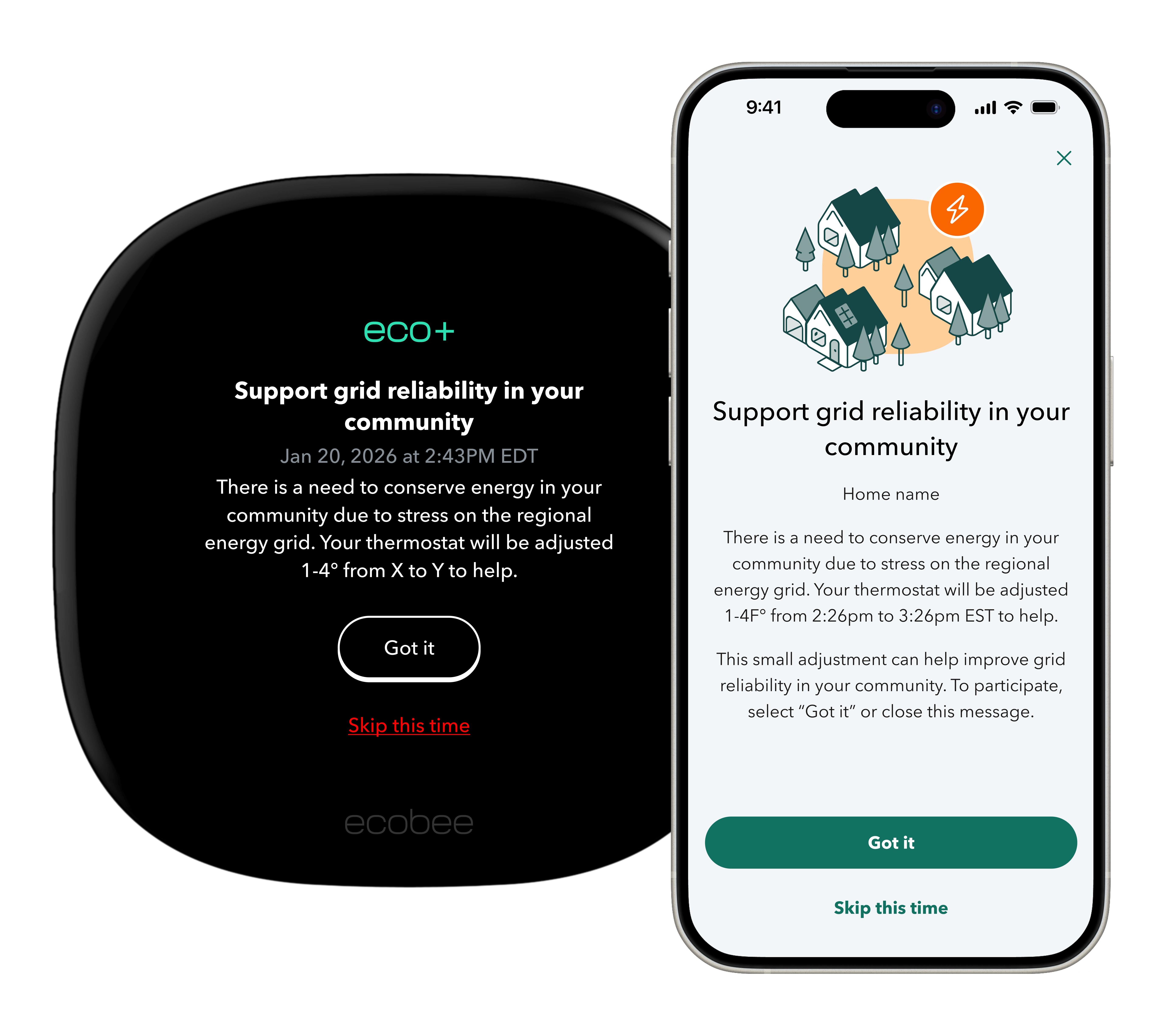
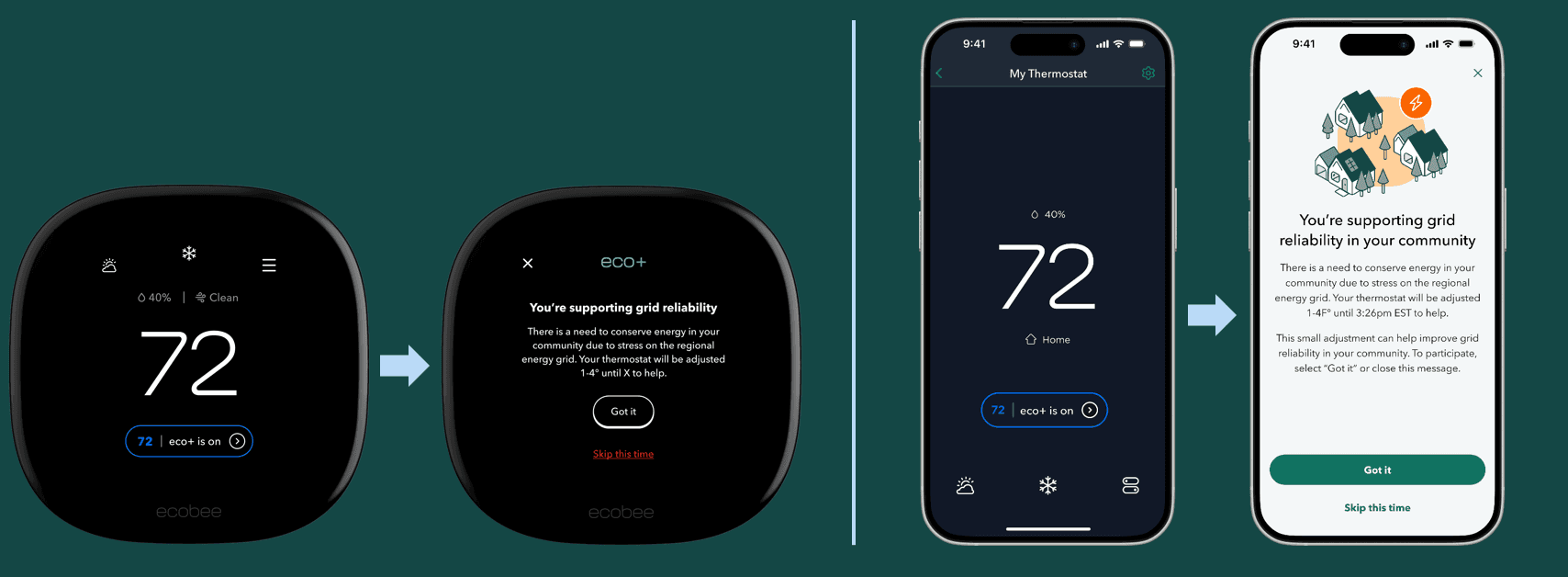
ecobee built its simplified enrollment approach around clear communication, in-app transparency, and comfort-first design. Customers received multiple notifications, easy access to information, and full control to skip critical events or leave the program at any time.
Transparent Messaging
ecobee’s communication strategy centered on honesty, clarity, and empowerment. Customers were clearly informed about what to expect and why participation mattered.
Advance notifications explained that their thermostat could make small, temporary adjustments to help support grid reliability.
In-app and thermostat alerts made it easy to skip an event, before, or during activation.
Customers were informed of community benefits and user control; participation helps improve grid reliability and reduce stress on the grid, and customers were provided the pathway to opt out at any time.
Comfort-First Design
No manual enrollment steps: Eligible customers were directly enrolled.
Small, reversible adjustments: 1–4°F temperature changes, always within comfort limits determined by the customer.
Full control preserved: Customers could opt out at any time using the mobile app, thermostat display, or by manually changing their setpoint.
By combining transparency with flexibility, ecobee ensured customers stayed comfortable, confident, and in control of their participation.
Leap’s Role: Enabling Automated Dispatch at Scale
The success of the simplified enrollment model created a new operational hurdle: managing fast, consistent dispatch performance across a rapidly growing thermostat fleet. Leap’s Dispatch API solved this by enabling ecobee to instantly receive dispatch signals about critical grid events, so they could quickly respond within ERCOT’s 30-minute window. This automation layer enables ecobee to maintain consistent, reliable event performance across its entire portfolio.

Stephanie Cole
Marketing Director, Leap
"When grid services programs remove enrollment friction while preserving transparency and control, participation can expand dramatically. ecobee's Grid Resiliency service demonstrates a pathway to unlocking the full potential of connected devices to support grid reliability.”
About
ecobee
ecobee Inc. was founded in 2007 with a mission to simplify everyday life while creating a more sustainable world. Since launching the world’s first smart thermostat in 2009, ecobee has helped customers across North America save over 41.2 TWh of energy, which is the equivalent of taking all the homes in New York City off the grid for a year. Today, ecobee continues to innovate with smart home solutions that solve everyday problems with comfort, protection, and conservation in mind. In 2021, ecobee joined Generac Holdings Inc. (NYSE: GNRC), a leading global designer and manufacturer of energy technology solutions, and other power products. Generac and ecobee share a vision to deliver a cleaner and more sustainable energy future for customers and communities. The Generac and ecobee home is more comfortable, secure, resilient, and efficient. For more information, visit ecobee.com.